

“They said I’d hit the ground running. Instead, I felt like I was building my own runway.”
An anonymous new hire’s first month.
That line hits hard, doesn’t it? Imagine joining somewhere full of hope, only to find systems that don’t work, leaders too stretched to lead, and values that sound good but don’t land.
That kind of gap between promise and reality is precisely why Employer Brand Experience matters, and why it demands more than just corporate clichés.
This is not just an onboarding hiccup. It is where a brand slips. And not your consumer brand, your Employer Brand. Because what people experience on the inside will always be told on the outside.
Let’s start with a flashback
A recent grad lands her dream job at “…”. The recruitment process felt personal, the culture sounded electric, and the team seemed like family. Six weeks in, she’s overwhelmed; a lot of onboarding was missing, her manager is often unreachable, and the “open culture” feels more like chaos.
Meanwhile, a mid-level manager in another part of the company logs in on a Monday morning and is greeted by clarity, her team knows the roadmap, they’ve already got the tools, and there’s space for her to coach, not micromanage.
Two people, two realities, both under the same Employer Brand umbrella.
What is Employer Brand Experience, really?
Employer Brand is the gap-closer between what you say as an employer and what people feel when they work for you. It’s not just a recruitment campaign; it’s your everyday reputation.
Think of it in three layers.
- Identity
Who you say you are (values, promise, mission) - Experience
How work feels, day to day, across systems, leaders, space, tools - Narrative
What people share (inside and outside), whether you control it or not
Here’s a little analogy.
Your Employer Brand is like that restaurant’s menu. If you advertise “gourmet experience” but serve cold burgers in soggy buns, people will talk, and not in your favour.
Your brand doesn’t disappear once someone signs the contract. It’s an expectation, critiqued, shared.
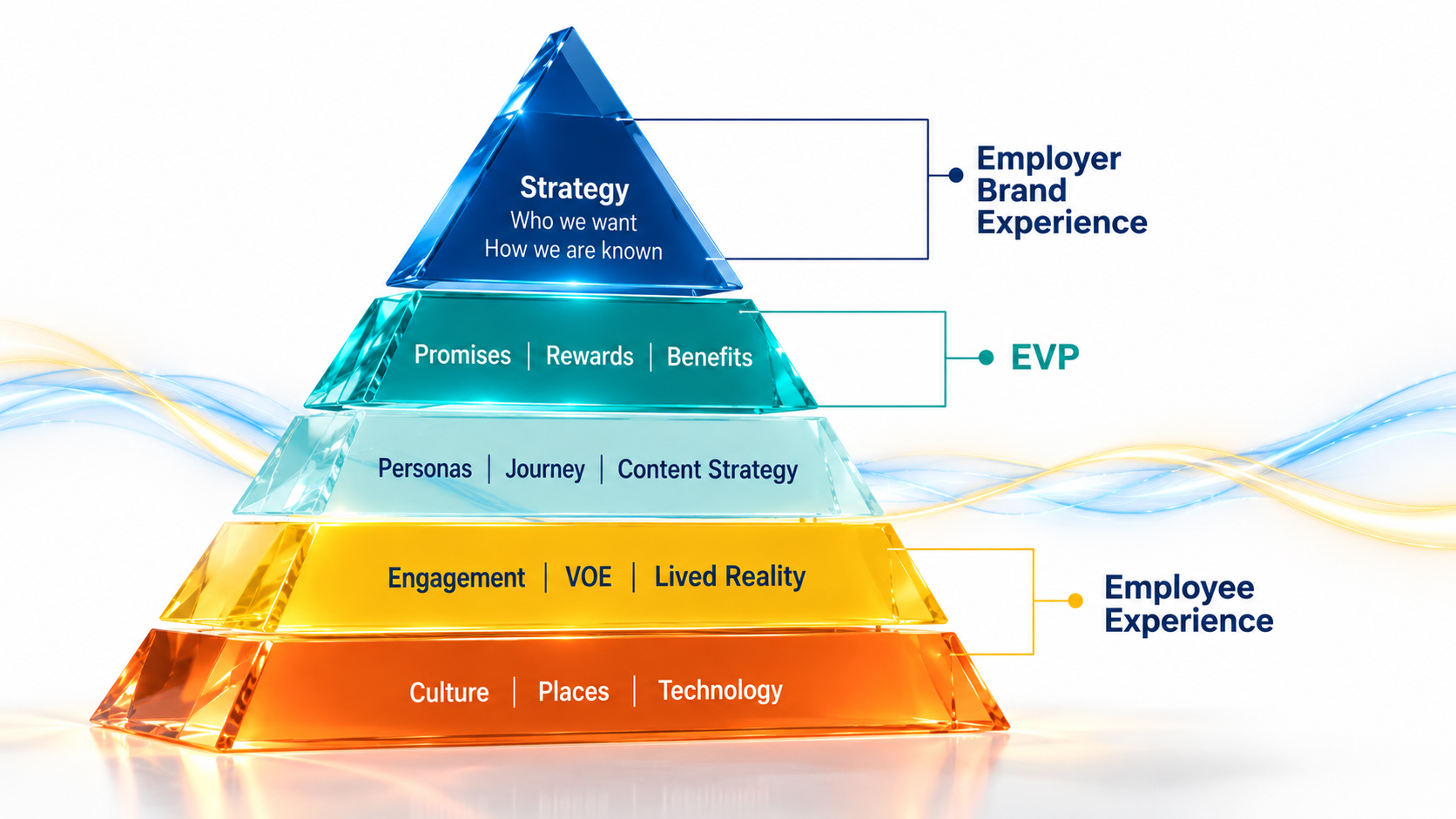
Employer Brand ≠ EVP ≠ EX
Too often these terms get blurred. Here is the sharp distinction.
- EVP is the deal, the promise of what people can expect.
- EX is the test, the lived, day-to-day experience.
Employer Brand is the reputation that forms when promise and practice collide. It is what employees, alumni and candidates tell the world on Glassdoor, TikTok, LinkedIn, WhatsApp groups, or over coffee chats.
Employer Brand is reputational capital. You do not own it – you influence it. And it carries weight with talent, the market, customers and investors alike.
Why this isn’t just HR fluff
Put simply, when you invest in the lived experience of your people, you’re not only shaping pride and retention; you’re fuelling your bottom line. Spoiler… people notice.
- 75% of job seekers cite a company’s reputation as a deciding factor before applying.
- Organisations that improve their Glassdoor ratings by 5 points get 20% more job clicks and 16% more apply starts. Glassdoor
- Investing in employer branding can reduce turnover by 28%. Vouch+1
- Only 21% of U.S. employees strongly agree with the statement “I trust the leadership of this organization.” Gallup.com
- Globally, employee engagement is alarmingly Only 20% of workers are engaged and “thriving at work.” The Comms Guru
These aren’t just numbers, they’re symptoms. When people feel disconnected, disengaged, or misled, the cost shows up in attrition, brand damage and lost momentum.
But stats aside, here’s the deeper point.
Jacob Morgan’s Employee Experience Equation, adapted in our own framework, makes it crystal clear that Culture, Technology and Splaces (spaces and places) aren’t “nice-to-haves.” They’re the three drivers that fuel growth, innovation, productivity, profitability, and customer satisfaction.
Put simply, when you invest in the lived experience of your people, you’re not only shaping pride and retention, you’re fuelling your bottom line.
Why CEOs and Boards should care
- 75% of job seekers cite a company’s reputation as a deciding factor before applying.
- A half-point Glassdoor boost delivers 20% more job click s and 16% more apply starts.
- Investing in employer branding reduces turnover by 28%.
- Only 21% of employees strongly trust their leadership.
Why Employer Brand is a boardroom issue (not an HR project)
Employer Brand too often gets parked under HR, filed under “soft stuff.” But the truth is, it’s a business lever that directly shapes execution, growth, and risk.
Talent = Strategy execution
Employer Brand too often gets parked under HR, filed under “soft stuff.” But the truth is, it’s a business lever that directly shapes execution, growth, and risk.
Reputation = Risk and growth
Your Employer Brand is reputational capital. It shapes investor confidence, customer trust, and your ability to attract top talent. In a world where brand sentiment spreads faster than your annual report, reputation isn’t fluff. It’s fuel.
ROI is tangible
A strong Employer Brand reduces turnover, shortens time-to-hire, and lifts productivity, which all compound into profit. (Glassdoor’s data shows that a half-point increase in rating leads to 20% more job clicks and 16% more apply starts; LinkedIn data links strong employer brands to 50% lower cost-per-hire.)
Culture = Competitive advantage
Companies with aligned values and lived integrity outperform peers on innovation, agility and customer satisfaction. Culture isn’t decoration; it’s the differentiator that can’t be copied.
The narrative is already out there
Your Employer Brand is being written every day – in WhatsApp groups, Glassdoor reviews, LinkedIn posts, even TikToks. The question isn’t if there’s a story, but who’s writing it.
What's your story (even when no one’s watching)?
- What story would your employees tell if your HR team vanished tomorrow?
- If your EVP (Employee Value Proposition) were erased, could your employees still reconstruct it?
- Is your brand something you craft, or something you hope for?
These questions are not just rhetorical. They’re diagnostic.
What happens when your brand works
- Magnet for the right talent
You attract people who align with your values, not just the ones chasing paychecks. - Loyalty, not turnover
People stay, grow and become advocates. - Crisis resilience
When your reputation is built by employees, one bad quarter doesn’t flip your image. - Efficiency gains
Fewer re-hires, quicker onboarding, lower hiring costs. - Authentic brand stories
Real stories that land because they’re true, not manufactured.
One more stat to illustrate, a one-star boost in Glassdoor rating increases the likelihood that employees stay in their next role by about 4%. DSMN8
Think of it this way: your Careers page is the menu. But your brand is the meal served and the reviews that follow. Cold burgers in soggy buns do not get forgiven, no matter how beautiful the menu looked.
Our view: from promise to proof
We use a simple framing.
- EVP is intent.
- EX is the test.
- Brand is the reputation you earn, and the one you craft.
Our frameworks help organisations close the gap from promise to proof.
Where to begin without burning down the house
- Surface your real identity, not the slogan you want but the truth of who you are.
- Map where reputation is shaped, onboarding, exit interviews, alumni networks, Glassdoor.
- Listen before you fix, surveys, interviews, and yes, whispers.
- Close the gap, align promise and practice with tools, leadership and lived experience.
- Iterate, measurement and adaptation are not optional. They are the work.
Your brand speaks, with or without you
Your Employer Brand isn’t optional. It’s not a campaign. It already exists, like we said, in employee chatter, LinkedIn reviews, internal jokes, exit interviews, in WhatsApp chats, on TikTok, in alumni stories. The question isn’t if your brand is talked about; it’s how.
If you remain passive, you let the narrative drift. If you step in, you make it stronger, more human, more real and ultimately, more profitable.

Next Step
Make the promise
feel true
Strengthen your Employer Brand and EVP around what people value, what your organisation can genuinely deliver and what employees experience after they join.
Frequently Asked Questions (FAQs)
What is Employer Brand experience?
Employer Brand Experience is the reputation that forms when what an organisation says as an employer meets what candidates and employees actually experience. It develops through identity, everyday workplace experience and the stories people share inside and outside the organisation.
What is the difference between Employer Brand, EVP and Employee Experience?
EVP is the employment promise and value exchange. Employee experience is how that promise is tested in day-to-day work. Employer Brand is the reputation that forms around the promise and the experience, shaped by what candidates, employees and alumni believe and share.
Why should CEOs and boards care about Employer Brand?
Employer Brand affects the organisation’s ability to attract and keep capability, execute strategy and protect reputation. When promise and reality drift apart, the cost can show up in hiring, retention, trust and lost momentum. That makes Employer Brand a business and risk issue, not only an HR concern.
How can organisations close the gap between employer promise and reality?
Start with the real identity and the evidence employees already experience. Map where reputation is shaped, listen before fixing, and compare the promise with onboarding, leadership, systems, culture and employee stories. Then focus on the gaps that most weaken trust or make the employer promise harder to believe.
How should Employer Brand Experience be measured?
Start with the outcome the Employer Brand is expected to support. Useful measures may include candidate quality, job clicks, applications, time to hire, onboarding experience, retention, advocacy and employee recognition of the promise. Use the measures to test whether reputation is strengthening because the lived experience supports it.
- By Sally Acton , Chief Experience and Innovation Officer, LRMG Sally Acton is Chief Experience and Innovation Officer at LRMG. She works with organisations across Employee Experience, Employer Brand and EVP, and Inclusion and Culture, helping leaders turn employee insight into practical strategies, journeys and experiences that people can feel in everyday work.