AI-ready roles: the skills visibility gap leaders cannot ignore
Across the African markets LRMG serves, AI adoption is moving from interest to implementation. Leaders are investing in tools, pilots, platforms and training, while teams are experimenting and finding their own use cases.
The pressure to build AI skills is moving faster than many learning strategies can keep pace with. Organisations need AI capability quickly, but many are still responding with courses before they have enough skills visibility to know which roles to prioritise, where gaps remain and what support people need next.
For many HR, L&D and Talent leaders, the starting point is AI skills training. The harder question is whether that training is building AI-ready roles in the parts of the organisation that need capability most.
In the market, the question often sounds like this: “How do we train everyone on AI?”
It’s a fair starting point, but not the full question. A stronger question is: “Can we see, assess and strengthen AI readiness by role?”
This is the AI skills visibility gap: AI learning may be happening, but leaders cannot yet see which roles are building capability, where gaps remain or whether learning is moving into real work.
Without that view, leaders can mistake interest for capability. People may be confident but exposed, trained but untested, or experimenting without enough support.
This is the conversation behind Ready for AI skills at scale? A 5-question playbook for HR, L&D and Talent leaders who need to look beyond broad AI training and pressure-test whether they can see where skills, roles and readiness gaps need attention.
AI-ready roles need technical fluency, decision-making and business context
AI-ready roles aren’t built by giving every employee the same learning journey. They are built by understanding what each role needs to know, decide and do differently with AI.
At LRMG, we find it helpful to look at AI-ready capability through three lenses: technical fluency, human decision-making and business context.
Technical fluency helps people understand what AI can and cannot do. Human decision-making helps them question outputs, manage risk and take accountability for the final action. Business context helps them apply AI in ways that improve real work, not just speed up isolated tasks.
For a customer service agent, that might mean using AI to draft a response but still recognising when the customer’s issue needs escalation or engagement with a real person. And a sales leader, it might mean using AI to prepare for an account conversation, while still reading the relationship, the buying context and the commercial risk. For an HR business partner, it might mean using AI to summarise engagement themes, while still protecting confidentiality and interpreting the human signals behind the data.
Business-relevant and role-relevant learning material still has an important role to play. It can build AI awareness, explain key concepts and support more technical, role-specific development. But learning content needs to sit inside a broader readiness approach that includes role pathways, practice and evidence of application.
In the rush to respond to business pressure, AI skills training can become a quick fix: find the content, launch the learning, track completions and report activity. But activity alone won’t show whether the right roles are building the right capability.
Leaders can’t strengthen what they can’t see.
How AI skills training becomes visible, role-based and measurable
In market conversations across the continent, we are hearing a common concern: AI learning is happening, but it is often spread across different systems, teams, platforms and reporting infrastructure.
When HR, L&D and Talent leaders are working with fragmented learning ecosystems it’s a tough job to answer the big question asked by the business: Where is AI learning improving work and the quality of outputs?
The missing link is connected skills visibility. Leaders need to connect the skills the business needs, the roles most affected by AI, the learning people complete, the practice they still need and the evidence leaders can use to guide the next decision.
A connected learning ecosystem helps HR, L&D and Talent leaders connect skills, roles, learning pathways, and reporting, so they can build a clearer, organisation-wide view of where readiness is developing.
As Skillsoft’s Authorised Partner in Africa, LRMG helps organisations use these capabilities as part of a broader workforce readiness strategy, connecting access to the visibility, pathways and practice needed to build AI capability at scale.
“Skillsoft is valuable here because it helps organisations move beyond course access into a more visible skills ecosystem. Skills Benchmark capabilities help identify internal proficiency or capability gaps, while role-aligned development pathways give people a clear route from general awareness to the critical skills they need to master in their evolving roles. CAISY™ AI simulations enable employees to test understanding and decision-making safely, and dashboards give leaders a clear view of skill growth and strategic readiness”, says Omri Yaari, Managing Director, LRMG SA.
What this looks like in practice
We have seen this shift in practice with a major telecommunications player operating across the continent. Their future-skills approach used Skillsoft’s Percipio platform to connect learning access with AI skill benchmarks, role guidance, skills practice and CAISYTM AI Simulator.
In 2025, the organisation passed one million Percipio learning content accesses. More importantly, it began moving towards a more visible skills ecosystem. Reported gains followed in uptake, skill application and learner experience scores.
What anchors the skills ecosystem
Skillsoft can help create a more connected skills ecosystem. LRMG’s Workforce Readiness FrameworkTM adds another layer. It helps leaders see what needs to be in place for learning to move from implementation to adoption, and from adoption to organisation-wide readiness.
At LRMG, we look at workforce readiness challenges through four workforce readiness gaps: skills, visibility, inspiration and agility.
The skills gap asks whether people have the technical fluency, human decision-making skills and role-specific capability to apply AI responsibly in their roles. Closing skill gaps helps clarify what capability needs to be built, and for whom.
Visibility gap asks whether leaders can see where readiness is building, where gaps remain and which roles need support first. Closing visibility gaps gives leaders a clearer view of where to prioritise effort and how to adjust learning plans.
Inspiration gap asks whether people have sufficient confidence, context and momentum to use the skills they’ve gained in ways that improve their work. Closing inspiration gaps helps adoption continue by making learning feel relevant, useful and worth returning to.
Agility gap asks whether the organisation can adapt fast enough as AI changes workflows, decisions, policies and customer expectations. Closing agility gaps helps leaders keep capability-building responsive as work continues to change.
When these gaps are unclear, activity alone won’t show whether AI-ready roles are being built. Closing the gaps helps leaders understand whether the right skills are being built in the right places, with the right support.
What leaders need to see before they can build with confidence
For HR, L&D and Talent leaders, the challenge has moved beyond making learning available to building the visibility needed to make better learning decisions.
Skillsoft’s 2025 Global Skills Intelligence Survey points directly to this issue. The research shows that only 10% of HR and L&D professionals are fully confident that their workforce has the skills needed to meet business goals over the next 12 to 24 months. Leadership, AI and technology were identified as the most significant skill shortages.
Many organisations already have learning programmes, platforms and development plans in place. What they often lack is the skills visibility to decide which roles, gaps and learning investments need attention first.
Skillsoft’s research also shows most organisations have skills development plans. Far fewer believe those plans are strongly aligned to strategic objectives.
The warning is clear: if skills are becoming a growth and workforce readiness issue, then skills visibility cannot remain a reporting afterthought.
Leaders should be asking:
- Which roles need AI capability first?
- Where do people need practice before applying AI in their work?
- Which skills are growing, and which gaps remain?
- Where are managers seeing confidence, hesitation or risk?
- Can we see whether learning is improving the quality, speed or confidence of the work?
- What support do different roles need next?
These signals help leaders move from reporting on learning activity to guiding workforce readiness: where to prioritise, where to deepen learning and where to provide more support.
Ready to build an AI-ready workforce?
AI readiness goes beyond ensuring access to AI skills training. It’s about providing your organisation with a clearer view of which roles are ready, where people need support and what needs to happen next.
At LRMG, we help organisations think strategically about the skills, pathways, platforms and practical learning experiences needed to build workforce readiness.
For organisations ready to move from broad AI awareness to measurable AI capability, LRMG’s Skillsoft learning solutions can help. They build targeted development pathways, close skills visibility gaps and support practical capability-building.
AI-ready roles need more than access to AI learning. Leaders need to see which skills are growing, where gaps remain and what support different roles need. This matters before learning activity expands too quickly.
Download the Ready for AI skills at scale? to pressure-test your current level of clarity across skills visibility, learning relevance, practice, adoption support and proof of progress.
Use it to start a more focused conversation about what is clear, what is still being assumed and where your AI skills plan may need more structure.
Frequently asked questions about AI skills readiness
What is AI readiness?
AI readiness is the organisation’s ability to help people use AI confidently, responsibly and effectively in the work they do. Strong AI readiness also gives leaders a clearer view of which roles are ready, where gaps remain and what support people need next.
Why are human skills important in AI adoption?
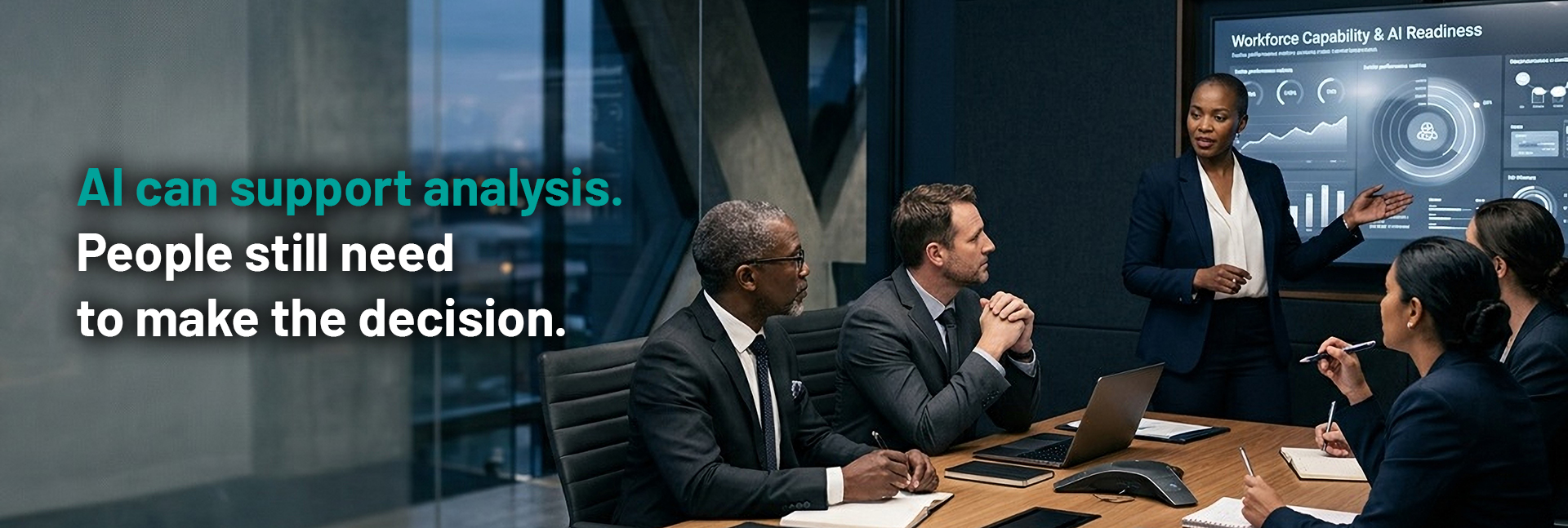
Human skills help people question outputs, manage risk, understand context and make better decisions when using AI. AI can support analysis, content creation and workflow improvement, but people still need to interpret information, communicate clearly and take accountability for the final decision.
What skills do employees need to work with AI?
Employees need AI literacy, critical thinking, ethical decision-making, communication, collaboration and role-based application skills. They also need opportunities to practise using AI in real work situations, beyond learning about AI in theory.
How can organisations assess AI readiness by role?
Organisations can assess AI readiness by defining the AI skills each role needs, assessing current capability, identifying gaps and building targeted learning pathways.
This helps leaders move from broad AI awareness to a clearer view of which teams are ready, which roles need support and where capability needs to be strengthened.
Why isn’t AI training enough?
AI skills training can build awareness, but readiness depends on whether people can apply AI in real work. People need to know how to use AI responsibly inside the workflows, decisions, customer realities and performance pressures of their roles.
What is the AI skills visibility gap?
The AI skills visibility gap is the gap between AI learning activity and what leaders can actually see. People may be completing AI training, but leaders still need to know which skills are growing, which roles are ready, where gaps remain and what support people need next. Without this visibility, organisations can mistake learning activity for workforce readiness.
- By Francis Karingi Nduta, Managing Director & Senior Partner, LRMG Africa
Based in Nairobi, Kenya, Francis works with organisations across the African continent to connect workforce readiness, leadership, learning strategy and technology-enabled capability building to business performance.